Tunnel testing with the relatively new 'quonset hut' style tunnels has always bothered me.
Lets be clear, the purpose of the tunnel test to to check if there is any point along a ride where guests can reach out and smack something at a high rate of speed causing themselves injury, or in the case of two passing trains, cause themselves and/or others bruising, broken limbs or dismemberment. This is not just good design sense but it is the kind of thing the mere thought of which makes lawyers froth at the mouth.
You are not going to see any modern coasters that have track which could allow trains to get this close to one another, not even in the same break zone, because while it is incredibly unlikely that you'll have such a tragic break failure, and the incredibly bad timing it would take for the cars to pass thus, you can not beyond a shadow of a doubt say it's impossible. And the lawyers are watching.
Can you picture a tragic zone failure that not only allowed two or more trains to collide, which would eventually be the result, but that also allowed riders to dismember one another long the way? Lawyers get paid to picture that kind of thing, and make sure it can't happen.
It's incredibly hard to judge this kind of distance thing in NL which has no real measurement tools besides the track itself, particularly along the full length of a ride, and the tunnel test was a great way to do it. Back when the tunnel was a perfect tube that flowed along the track pretty much guaranteeing an equal distant measurement from the heart line. But this is no longer the case, the hut style tunnel not only does not guarantee an equal distance in all direction but also it does not flow with the banking of the track, so the distances change with the roll of the ride.
I do not think that this current tunnel style constitutes a valid 'tunnel test' in the true meaning of the test. In the given photo we cannot tell the orientation of the track in the other tunnel, if the track is rotated away from this track it might be fine, if it's not, it might not be fine. In either case it comes down to a judgment call.
In any event I completely disagree with the "something sticks into the tunnel, therefore it fails." ideal, its simply unrealistic. I'm sure most of us can think of rides where you can reach out and touch things while navigating a lift or a slow break run, speed makes a difference, and I can think of several rides where you can reach out and get your fingers stung by something while traveling at speed, so I'm not going to call someone on a 'tunnel test' failure unless its rather obvious some idiot could choose to seriously injure themselves on something (and no, that doesn't include small tree branches or bamboo fronds).
Be sure you're not looking in a mirror before you start pointing fingers.

 Home
Home Contact Us
 Discord
 Chat [0]
 Store
Store Exchange
 Forum
Forum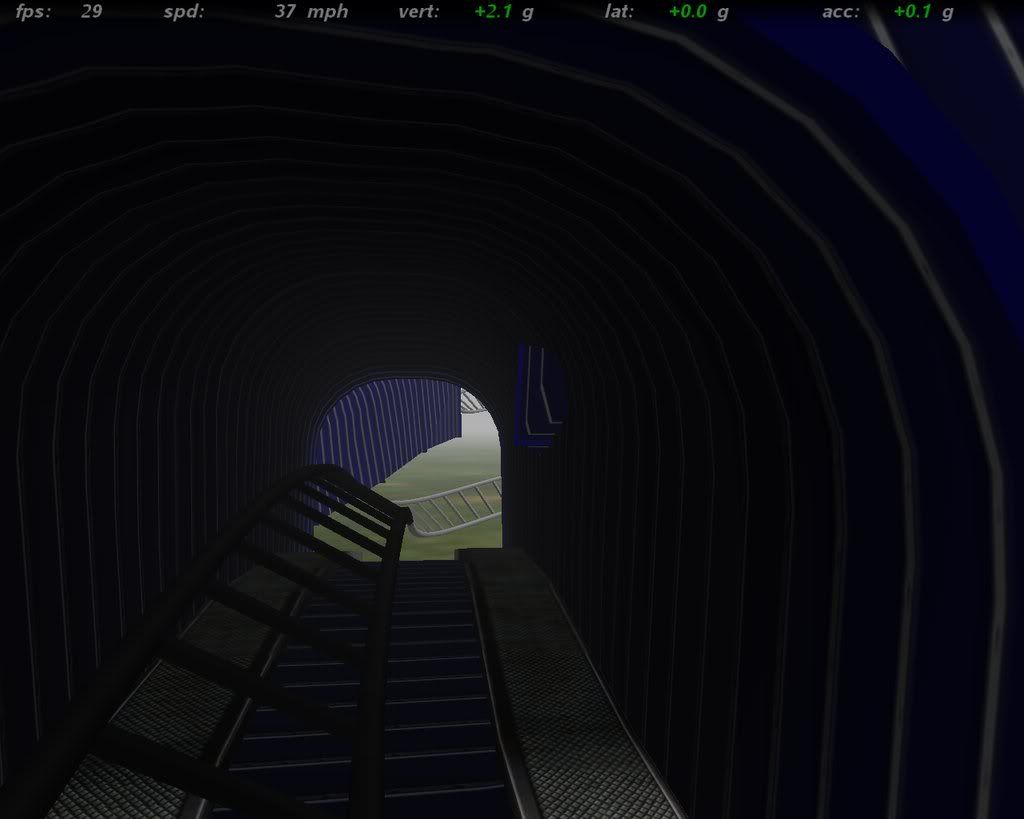
 September 29th, 2008, 8:31 pm